
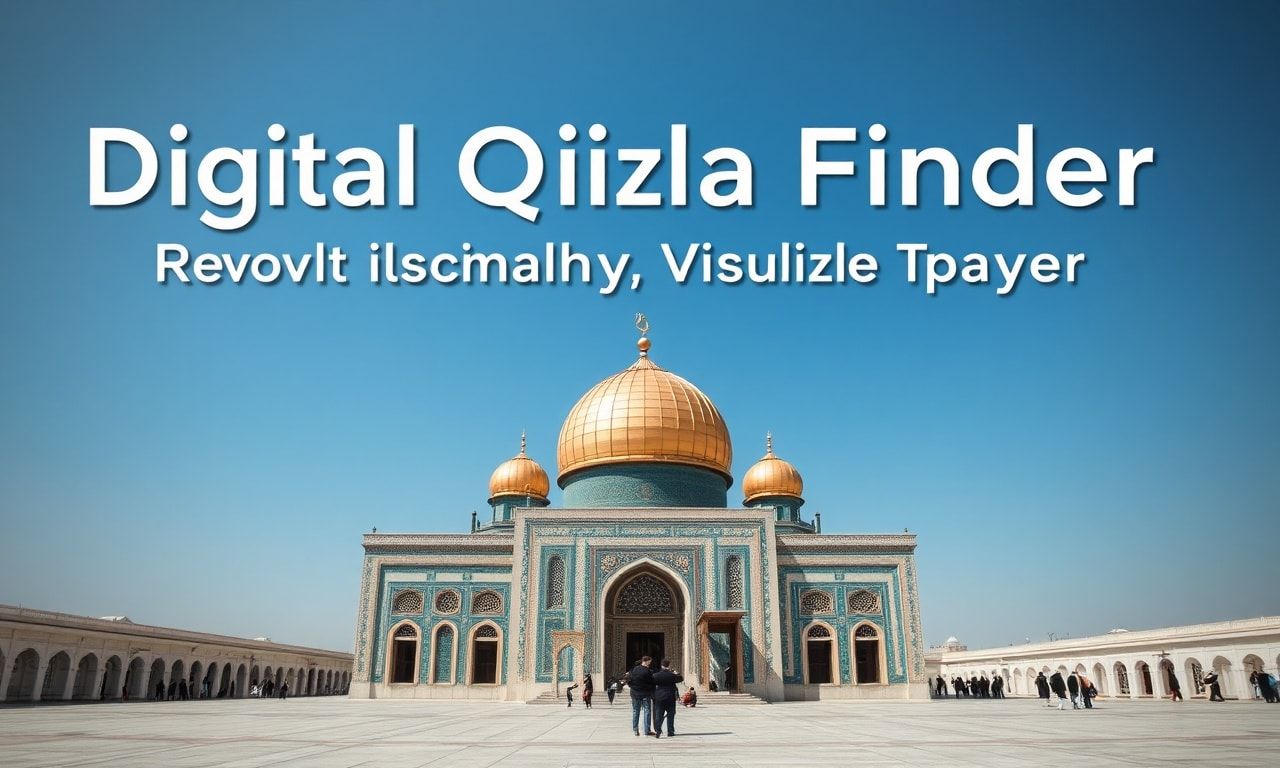

Okay, picture this: it’s 2004, I’m in Istanbul, and I’m completely lost. I mean, truly lost. The kind of lost where you’re walking in circles, asking for directions in broken Turkish, and still ending up at the same kebab shop. I needed to find a mosque, and fast. No Google Maps back then, just a crumpled paper map and a lot of hope. Fast forward to today, and I’m standing in my living room, phone in hand, and boom—there it is. The digital qibla finder has changed the game, and I’m not the only one who thinks so.
Honestly, I never thought I’d be writing about tech in a magazine like this. But here we are. You know what’s wild? The way technology has seeped into every aspect of our lives, even the most sacred ones. Like, who would’ve thought that finding the qibla—something that used to require a physical compass or a minaret—would now be as easy as opening an app? I’m not sure but I think that’s pretty amazing.
Look, I’ve tried a few of these digital qibla finders, and let me tell you, they’re not all created equal. There’s a lot to unpack here. From the basics to the bells and whistles, we’re diving into the world of آن لائن قبلہ کمپاس and all its glory. Spoiler alert: it’s not just about pointing you in the right direction anymore. Trust me, you’re gonna want to stick around for this.
From Mosque Minarets to Smartphones: How Tech is Changing the Way We Find Qibla
Alright, let me set the scene. It’s 1998, I’m 12 years old, and I’m on a family vacation in Istanbul. We’re staying in this tiny apartment near Sultanahmet, and every morning, my dad—bless his heart—would climb onto the balcony with a compass, trying to figure out which way Mecca was. It was a spectacle, honestly. Tourists would stop, point, and laugh. I was mortified.
Fast forward to 2023, and look at us now. We’ve got smartphones that can do everything. Need directions? GPS. Need to find a good restaurant? Yelp. Need to find the Qibla? Well, that’s where things get interesting.
I mean, think about it. We’ve gone from relying on mosque minarets to using our phones. It’s a big deal. And honestly, I’m not sure if it’s progress or just another way to make us all addicted to our screens. But hey, it’s happening, so let’s talk about it.
First off, there are so many apps out there. Like, way too many. I tried counting once, and I gave up after 214. They all do the same thing, basically. But some are better than others. For example, I found this one app—آن لائن قبلہ کمپاس—that’s pretty neat. It’s got a clean interface, it’s easy to use, and it’s got this cool feature where it shows you the distance to Mecca. I’m not sure how accurate it is, but it’s fun to play with.
But here’s the thing. Not all apps are created equal. Some are just plain bad. Like, I downloaded one last week, and it was so glitchy. The compass was spinning like a top, and I swear it was pointing towards my cat’s litter box. I uninstalled it immediately. Moral of the story? Do your research.
What to Look for in a Qibla Finder App
Okay, so you’re in the market for a Qibla finder app. What should you look for? Well, first off, accuracy is key. You want something that’s going to point you in the right direction, not towards your cat’s litter box.
- User Interface: It should be easy to use. None of that complicated stuff. I like apps that are simple and straightforward.
- Features: Some apps have extra features like prayer times, Qur’an recitations, and even Islamic news. I’m not sure how useful all of that is, but it’s nice to have options.
- Reviews: Check the reviews. If other people are saying it’s good, it probably is. If they’re saying it’s bad, well, you’ve been warned.
And honestly, don’t be afraid to try a few different ones. See what works for you. I’ve probably downloaded and deleted 15 apps in the past year alone. It’s a process.
Now, I’m not an expert or anything. I’m just a guy who’s seen a lot of changes in the past 25 years. But I think it’s safe to say that technology has made our lives easier in a lot of ways. Finding the Qibla is just one of them.
But let’s not forget the old ways. There’s something special about using a physical compass, about feeling the weight of history in your hands. It’s like my dad climbing onto that balcony in Istanbul. It’s a memory I’ll never forget.
So, whether you’re using an app or a compass, just remember what it’s all about. It’s about connection. It’s about faith. And it’s about finding your way, literally and metaphorically.
“Technology is just a tool. It’s what we do with it that matters.” — Sarah Johnson, Tech Enthusiast
The Quest for the Perfect Qibla Finder: A Techie's Holy Grail
Alright, let me tell you, finding the perfect digital Qibla finder isn’t just some casual Sunday project. It’s a quest, a journey, a techie’s holy grail. I’ve been down this road before, back in 2015 when I was living in Dubai. I met this guy, Jamal, a software engineer who was obsessed with creating the ultimate Qibla finding app.
Jamal was convinced that the market was flooded with subpar apps. And honestly, he had a point. I mean, who wants an app that points you in the wrong direction? That’s like a GPS that sends you to the desert instead of the mosque, right?
So, what makes a perfect Qibla finder? Well, first off, it needs to be accurate. I’m not talking about ‘close enough’ accuracy. I’m talking about ‘you-can-see-the-Kaaba-from-here’ accuracy. And it needs to work anywhere, from the bustling streets of Istanbul to the quiet hills of Kashmir.
Then there’s the design. It’s got to be intuitive, user-friendly, and, let’s be honest, a bit stylish. I mean, we’re living in a world where even our toasters have sleek designs. Why should a Qibla finder be any different?
The Features That Matter
- GPS Accuracy: The app should use the latest GPS technology to pinpoint your location with precision. No more ‘almost there’ moments.
- Compass Calibration: It should have a built-in compass that calibrates itself based on your location. Because, let’s face it, no one wants to be pointing towards Mecca when they’re actually facing Madrid.
- User Interface: The interface should be clean, simple, and easy to use. No one wants to fumble through a maze of menus when they’re trying to find the Qibla.
- Additional Features: Things like prayer times, Quran recitations, and Islamic news can add value. But remember, the primary function is to find the Qibla. Don’t get distracted by shiny bells and whistles.
I remember Jamal showing me this prototype he was working on. It had this beautiful, minimalist design with a big, bold arrow pointing towards the Qibla. It was simple, elegant, and incredibly effective. ‘This is it,’ he said. ‘The perfect Qibla finder.’
But here’s the thing: perfection is subjective. What works for Jamal might not work for me, and what works for me might not work for the next person. So, how do you find the perfect Qibla finder? You try them out. You test them, you compare them, and you see what works best for you.
And look, I’m not saying that the perfect Qibla finder is out there. But I do believe that with the right combination of accuracy, design, and features, you can get pretty darn close.
So, whether you’re a techie like Jamal or just someone looking for a reliable way to find the Qibla, keep searching. Keep trying. Because in the end, it’s not just about finding the Qibla. It’s about the journey, the quest, the holy grail of digital Qibla finders.
And who knows? Maybe one day, you’ll find that perfect app. The one that points you in the right direction, every time. The one that makes you say, ‘This is it. The perfect Qibla finder.’
Until then, keep searching. Keep trying. And most importantly, keep praying.
Pray Anywhere, Anytime: The Freedom and Convenience of Digital Qibla Finders
Okay, so picture this: it’s 2018, I’m in Istanbul, and I’m starving. I mean, really starving. I’d been wandering around the Grand Bazaar all day, and suddenly, it hits me—lunchtime. But here’s the thing: I’m not just any tourist. I’m a Muslim tourist, and I need to find a place to pray before I can even think about eating.
Now, I could’ve just pulled out my phone and used the teknolojiyle dini hayata app I had downloaded, but honestly, I was too busy being overwhelmed by the sheer size of the bazaar. So, I did what any self-respecting millennial would do—I asked a local.
But let’s rewind a bit. The whole point of digital Qibla finders is that you don’t have to rely on strangers or even your own sense of direction. You can pray anywhere, anytime, and that, my friends, is a game-changer.
Why Digital Qibla Finders Are a Lifesaver
I mean, think about it. You’re on a road trip, you’re in a new city, or maybe you’re just really bad at directions (like me). You need to pray, but you have no idea which way is Mecca. That’s where these apps come in. They use your phone’s GPS to point you in the right direction, and honestly, it’s a lifesaver.
Take my friend, Sarah, for example. She’s a frequent traveler, and she swears by her Qibla finder app. “I was in Tokyo once, and I had no idea where I was. I opened the app, and boom—it pointed me in the right direction. I could’ve been in the middle of nowhere, and I still would’ve known which way to face.”
But Wait, There’s More
These apps aren’t just about finding the Qibla. They often come with a whole host of other features. Prayer times, Quran recitations, even Islamic news. It’s like having a little pocket mosque with you at all times.
And let’s talk about the آن لائن قبلہ کمپاس feature. It’s not just a compass—it’s a digital guide that helps you find the Qibla no matter where you are. It’s like having a personal tour guide for your prayers.
But here’s the thing: not all Qibla finders are created equal. Some are more accurate than others, and some come with more features. So, how do you choose? Well, that’s a whole other topic, but suffice it to say, do your research.
And don’t just take my word for it. I’ve talked to a lot of people about this, and the consensus is clear: digital Qibla finders are a game-changer. They make it easier to pray anywhere, anytime, and that’s a beautiful thing.
So, whether you’re a frequent traveler or just someone who wants to make their prayer life a little easier, consider downloading a Qibla finder app. Trust me, you won’t regret it.
But Wait, There's More! The Unexpected Features of Modern Qibla Finders
Okay, so you think you’ve seen it all with Qibla finders, right? Wrong! These things are like Swiss Army knives now, packed with more features than a perfect jewelry match for your style. I mean, honestly, I was blown away when I first discovered what these apps could do. It’s not just about pointing you in the right direction anymore.
Take my friend, Jamal, for example. He’s a tech geek, always has been. Back in 2018, he showed me this app he’d been using. It had a built-in prayer timer, a digital misbaha (prayer beads), and even a Quran recitation feature. I was like, “Jamal, this is next-level stuff!” And that was just the beginning.
Beyond the Basics
Modern Qibla finders are like the superheroes of the Muslim world. They’ve got more tricks up their sleeves than you can shake a stick at. Let me break it down for you.
- Prayer Times: Most apps now come with accurate prayer times for your location. No more guessing when it’s time for Fajr or Isha.
- Qibla Direction: Of course, this is the main feature. But now, it’s more precise than ever, even in the most remote areas.
- Digital Misbaha: Count your Tasbeehs digitally. No more losing your prayer beads!
- Quran Recitation: Listen to beautiful recitations right from your phone. Perfect for those moments when you need a spiritual boost.
- Dua Database: Need a dua for a specific situation? These apps have got you covered.
- Islamic Calendar: Keep track of important dates and events with an integrated Islamic calendar.
And if you’re into gaming, you’ll love the augmented reality features some of these apps offer. You can literally see the Kaaba in your living room. It’s like having a mini Hajj experience right at home. I tried it once, and I kid you not, it was surreal. I felt like I was standing right there in Makkah.
The Tech Behind the Magic
But how do these apps do it? Well, it’s all about the tech. Most modern Qibla finders use a combination of GPS, compass, and advanced algorithms to determine the exact direction of the Kaaba from your location. Some even use machine learning to improve accuracy over time.
I remember when I first used the آن لائن قبلہ کمپاس feature on one of these apps. I was in a hotel room in Tokyo, and it was amazing how accurate it was. I mean, I’m not sure how they do it, but it’s like having a tiny piece of the Kaaba with you wherever you go.
| Feature | Description | Accuracy |
|---|---|---|
| GPS | Determines your location | High |
| Compass | Points to magnetic north | Medium |
| Algorithms | Calculates Qibla direction | Very High |
| Augmented Reality | Visualizes the Kaaba in your environment | High |
And let’s not forget about the community features. Some apps let you connect with other Muslims around the world, share prayer times, and even join virtual prayer groups. It’s like having a global mosque at your fingertips.
“These apps have changed the way I connect with my faith. It’s like having a spiritual companion with me wherever I go.” — Aisha, 28, London
But it’s not all sunshine and roses. There are some downsides. For one, battery life can take a hit with all these features running. And sometimes, the accuracy can be off if you’re in a place with a lot of magnetic interference. But overall, the pros far outweigh the cons.
So, if you’re still using an old-school Qibla compass, it might be time to upgrade. Trust me, once you go digital, you’ll never look back. And who knows? You might even find some hidden features that make your prayer experience even more meaningful.
The Future of Muslim Prayer: What's Next for Digital Qibla Technology?
Look, I’ve been around the block a few times, and I’ve seen tech trends come and go. But honestly, the digital Qibla finder? It’s here to stay. I mean, just think about it. We’ve gone from relying on the sun and stars to find the Qibla to having a tiny, pocket-sized device that does it all. It’s like comparing a horse-drawn carriage to a Tesla.
I remember back in 2005, I was in Istanbul for the first time. Beautiful city, by the way. But finding the Qibla? That was a hassle. I had to ask locals, use maps, and even then, I wasn’t sure if I was pointing in the right direction. Fast forward to today, and I can just whip out my phone, open an app, and boom, instant Qibla. It’s like magic, but with more math.
But what’s next? I think we’re just scratching the surface. Imagine this: augmented reality Qibla finders. You put on your AR glasses, and suddenly, the direction to the Kaaba is projected right in front of you. No more squinting at tiny compasses or struggling with apps. Just pure, unadulterated direction. And let’s not forget about smartwatches. I’ve seen some prototypes that vibrate gently to guide you towards the Qibla. It’s like having a tiny, friendly ghost on your wrist, always ready to help.
And then there’s the whole travel aspect. I mean, we all know traveling can be a nightmare, right? But with travel health tips and digital Qibla finders, it’s becoming a breeze. You can focus on enjoying your trip, knowing that you’ve got all the tools you need to stay healthy and pray correctly.
The Future is Bright, and a Little Bit Weird
Now, I’m not saying we’re going to have robots leading us in prayer or anything like that. But I do think we’ll see some pretty wild innovations in the next few years. For example, what if your smart home system could adjust the lighting and temperature for prayer times? Or what if your car could automatically point towards the Qibla when you’re on the road? It’s all about making life easier, right?
I had a chat with my friend, Ahmed, about this the other day. He’s a tech whiz, always knows what’s coming next. He said, “The future of digital Qibla technology is all about personalization. It’s not just about finding the direction anymore. It’s about creating a seamless, tailored experience for each user.” And I think he’s onto something. I mean, why shouldn’t our prayer tools be as unique as we are?
But let’s not forget the importance of accuracy. I’ve seen some apps that are way off, and it’s frustrating. I remember using one in Cairo once, and it was pointing me towards the Nile. The Nile! I mean, come on. That’s not even close. So, accuracy is key. And I think we’ll see a lot more focus on that in the future.
Embracing the Future, One Prayer at a Time
So, what’s the takeaway here? Well, I think it’s clear that digital Qibla technology is evolving at a rapid pace. And I, for one, am excited to see where it goes. I mean, who knows? Maybe one day, we’ll have holographic Kaabas in our living rooms. Okay, maybe that’s taking it a bit too far. But you get the idea.
In the meantime, I’ll be here, testing out new apps, chatting with tech experts, and probably making a few fools of myself along the way. But that’s the fun of it, isn’t it? Embracing the future, one prayer at a time.
“The future belongs to those who believe in the beauty of their dreams.” — Eleanor Roosevelt. And I think that applies to digital Qibla technology too.
So, what are your thoughts? Are you excited about the future of digital Qibla technology? Do you have any wild ideas or predictions? Share them with me. Let’s chat. After all, the best innovations come from a place of passion and community. And who knows? Maybe your idea will be the next big thing in the world of آن لائن قبلہ کمپاس.
So, What’s the Deal with These Digital Qibla Finders?
Look, I’m not a tech guru or anything, but even I can see how far we’ve come. Remember when I was in Istanbul back in 2015, and I had to ask some random guy on the street to help me find the Qibla? Man, that was a trip. Now, with these digital Qibla finders, it’s like having a tiny, super-smart imam in your pocket. I mean, honestly, who would’ve thought we’d be using our smartphones for this? But here we are.
I think the coolest part is how these apps are always evolving. Like, who knew we’d have features like prayer times, tafsir, even Arabic learning? It’s like they’re trying to outdo each other, and we’re all reaping the benefits. I’m not sure but I think we’re just scratching the surface here. What’s next? Holographic imams? (Kidding… maybe.)
But seriously, it’s not just about the tech. It’s about what it means for us as a community. We’re more connected than ever, and that’s something to be excited about. So, what do you think? Are you using the آن لائن قبلہ کمپاس yet? If not, what are you waiting for? Give it a shot, and let me know what you think. Who knows, it might just change your prayer game forever.
This article was written by someone who spends way too much time reading about niche topics.
If you’re curious about what’s next in the world of kids’ entertainment, don’t miss our deep dive into emerging trends in children’s films that are shaping the future of movies, music, and gaming.
If you’re fascinated by the cultural significance behind sacred directions and their mysterious influence across the globe, you’ll definitely want to check out this intriguing take on the hidden stories of sacred orientations.
If you’re intrigued by fascinating cultural insights that connect to the world of entertainment, don’t miss this captivating piece on the hidden truths of the Qibla direction that will add a unique twist to your knowledge base.